Royal Enfield Himalayan 750: Worth the Wait?
The Himalayan 750 pairs a 743cc air/oil-cooled twin with cornering ABS and cruise control. We look at the figures, the reported UK prices and the 450.
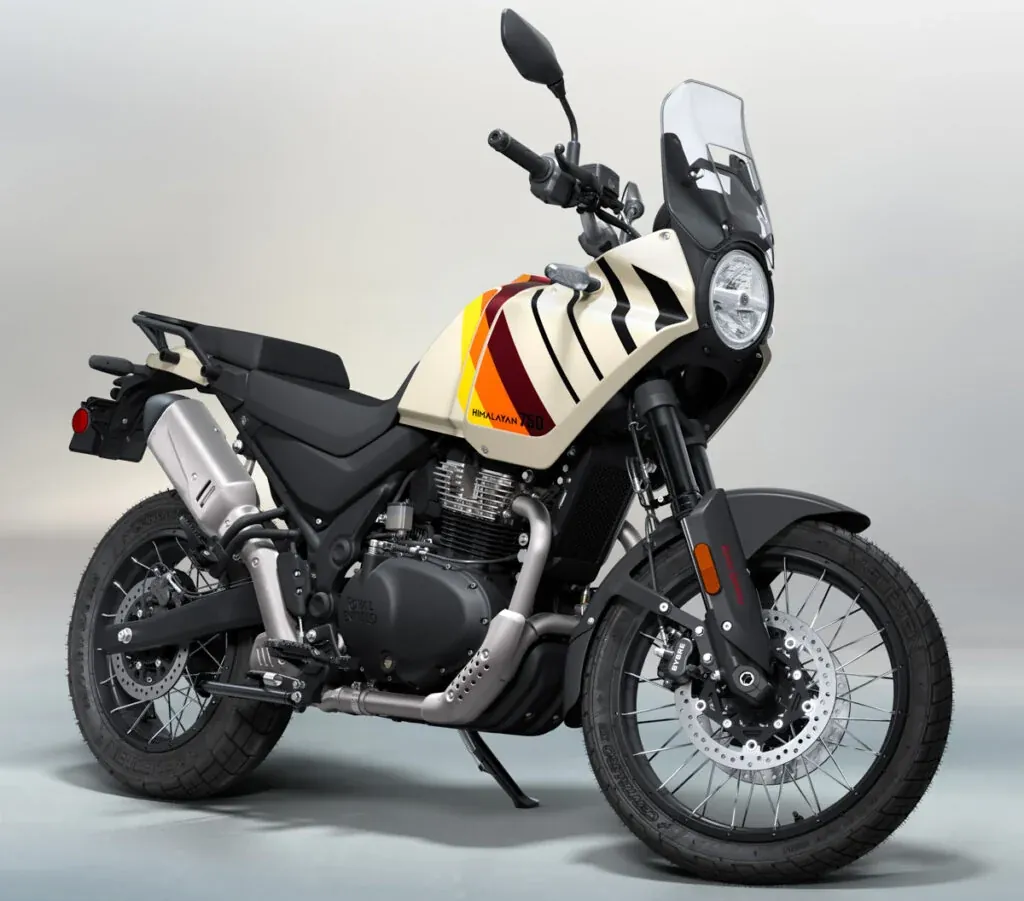
The Himalayan has always been a deliberately modest adventure bike. The original 411 and the current 450 are singles built to be light enough to pick up and simple enough to fix. The Himalayan 750 keeps the name and adds a second cylinder. The interesting question is how much of the original idea survives the move up.
What Royal Enfield has confirmed
Royal Enfield's official EICMA release gives these details for the Himalayan 750:
- Engine: new 743cc parallel twin, air/oil-cooled
- Torque: 63Nm at 5,000rpm, with about 90% of it available from 3,500rpm
- Wheels: 19-inch front and 17-inch rear, tubeless, in cast or spoked versions
- Electronics: five ride modes, a six-axis IMU, cornering ABS, lean-sensitive traction control and cruise control
- Touring parts: adjustable windscreen, separate rider and pillion seats
- Payload: 195kg
The release doesn't give a power figure, a weight, a seat height or a price.
Air/oil cooling is the surprise
The Himalayan 450 moved Royal Enfield's adventure bike to liquid cooling. The 750 goes back to air/oil cooling, the approach Royal Enfield's existing 650 twins use. On a bike pitched at long trips and rough tracks, that is a meaningful choice.
There are practical differences. Air/oil cooling avoids a separate water-cooling circuit, but an oil cooler and its lines can still be vulnerable to damage. It would be misleading to describe the engine as having no cooling hardware to protect. Cooling layout alone also does not determine an engine's power delivery. Royal Enfield's quoted torque figures are the better evidence of its intentions: most of the available torque arrives well below the reported peak-power speed.
Visordown's launch report quotes 54bhp at 7,000rpm. If that's right, the 750 is modest on paper for a 750cc twin, and less powerful than liquid-cooled middleweight adventure twins tend to be. That isn't necessarily a weakness, since this bike is about a flat, accessible spread of torque. But it does mean the 750 competes on character and price, not outright performance.
The reported chassis figures
Visordown also lists the following. None of it is in the official release, so treat these as reported figures until Royal Enfield UK publishes a specification:
- Suspension: fully adjustable 43mm Showa upside-down forks with 190mm of travel; a Showa shock with remote preload and rebound adjustment and 175mm of travel
- Brakes: twin 280mm front discs with two-piston calipers; a 255mm rear disc
- Weight and size: 223kg kerb weight, 815mm seat, 205mm ground clearance, 17.8-litre tank
- Dash and lights: a 4-inch round TFT with navigation, and a 7-inch LED headlight
Two details tell you where the bike is aimed. The twin front discs and 19-inch front wheel point to road riding: a heavier bike carrying a passenger needs more braking, and a 19-inch front gives a wider choice of road-biased tyres. The 190mm of fork travel is reasonable for gravel and green lanes, but well short of what dedicated off-road adventure bikes run. This looks like a touring twin that can handle a rough track, rather than a bigger 450.
223kg against the Himalayan idea
If the 223kg figure holds, that's a number Himalayan owners should consider carefully. Greater mass generally means more effort when pushing a motorcycle or picking it up, although balance and technique matter too. It does not automatically buy greater motorway stability: chassis geometry, tyres, suspension and luggage loading all influence that.
That's the real choice between the two Himalayans. The 450 stays the bike for riders whose trips get narrow and muddy. The 750 makes more sense for riders whose trips are mostly tarmac, often with a passenger. The official 195kg payload is one useful number here: rider, pillion and luggage will use up a good share of it, so it's worth adding up your own loaded weight before buying.
The reported UK prices
Visordown reports four UK versions: cast wheels in Aztec Green at £6,999, spoked wheels in Viking Bronze or Siberia White at £7,299, and Antarctic Silver with GIVI luggage at £8,699. The official release has no UK prices, and Visordown doesn't say where its figures came from, so check them with a dealer.
If those prices hold, the spoked version's £300 premium over the cast one is worth thinking about. Spoked rims are more forgiving of rocks, while cast rims are simpler to live with on the road. The luggage version's £1,700 premium is worth comparing with the cost of fitting luggage separately. If you'd rather compare it with a used twin at the same money, remember that an adventure bike's history matters more than most. Our used motorbike buying checklist covers what to look at.
For parts buyers
Royal Enfield describes a new 743cc engine but does not provide a parts-interchange list with its existing twins. A capacity change can come from bore, stroke or both; it does not establish exactly which components differ. Do not assume parts from the single-cylinder 450 or the 650 twins will fit without manufacturer application information and a part-number check.
What's still unknown
An official power figure and weight, a UK on-sale date, and how the air/oil twin copes with heat in slow traffic on a summer day. That last one is the question this cooling choice raises, and only road tests can answer it.