
Honda's Electric Compressor Explained: How the V3 900 Engine Works
Honda's V3R 900 E-Compressor uses electric boost to deliver strong torque from low revs. Here's how the technology works and why it matters.
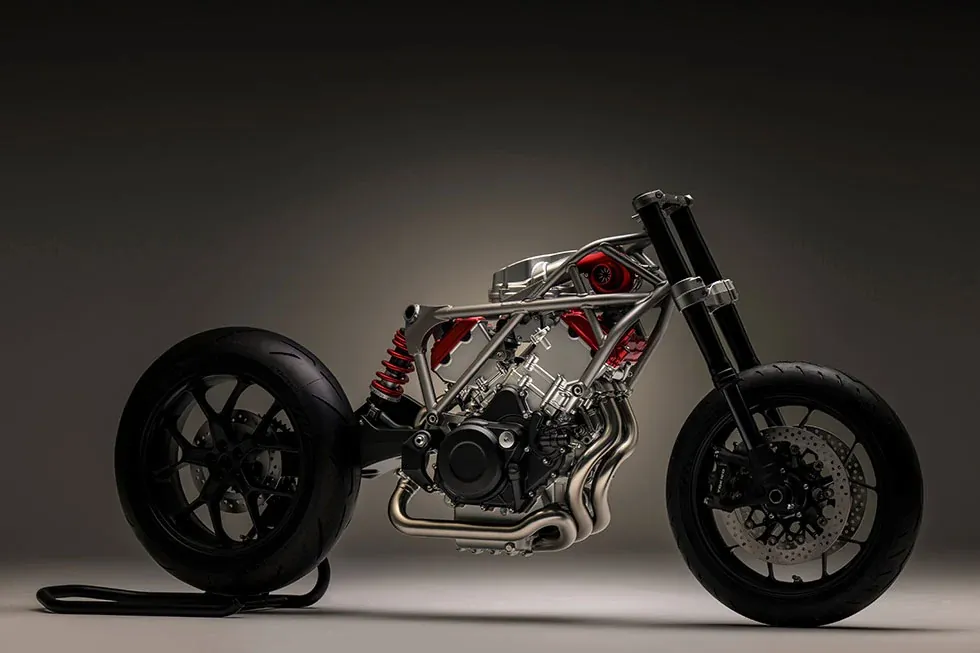
Honda has come up with something a bit different for its V3R 900 E-Compressor prototype. Instead of relying on a conventional turbocharger, this 900cc V3 uses an electronically controlled compressor to boost the air entering the engine.
It sounds complicated, but the idea is fairly straightforward: get more air into the engine and you can burn more fuel, potentially producing more power and torque. The interesting part is how Honda plans to deliver that boost.
What does the electric compressor actually do?
A normal naturally aspirated engine draws air in under atmospheric pressure. A compressor squeezes that incoming air, allowing more oxygen into the cylinders and giving the engine the potential to produce more torque.
Honda's system uses an electrically driven compressor, with boost controlled independently of engine speed. That matters because a conventional exhaust-driven turbo depends on exhaust gases to spin its turbine. At low revs, there may not be enough exhaust energy to deliver the response the rider wants.
An electrically driven compressor offers a different way of controlling boost. In theory, it can respond without having to wait for engine revs and exhaust flow to build in the same way as a traditional turbo.
Is it the same as a turbocharger?
Not quite. Both technologies force more air into an engine, but a conventional turbocharger uses exhaust energy to drive its compressor. Honda's approach uses an electric drive instead.
That doesn't mean the system is free of engineering challenges. Producing boost requires energy, and managing heat, electrical demand and reliability will all matter when the technology reaches production.
Honda has also said its design doesn't require an intercooler, which could help keep the overall package compact. That's particularly useful on a motorcycle, where space and weight are always at a premium.
Why use it on a 900cc V3?
Honda unveiled its original 75-degree V3 engine concept at EICMA in 2024, before showing the 900cc V3R E-Compressor prototype in 2025.
The company says it's aiming for performance comparable to a conventional 1200cc engine, while retaining the compact dimensions of a 900cc unit. That's a development target, not a published production specification, and Honda hasn't confirmed final power figures.
For road riders, the potential attraction is strong acceleration and useful torque without needing to keep the engine spinning at high revs. Whether the finished bike delivers that convincingly will depend on how the whole package performs, not just the headline technology.
When can we expect a production bike?
Honda has confirmed that development is continuing towards mass production, but that doesn't give us a confirmed UK launch date, price or final specification.
The idea is certainly intriguing. If Honda can deliver the response of a larger engine in a compact package, the V3 could offer something genuinely different from the usual four-cylinder sports bikes.
For now, though, the best thing is to separate the engineering promise from the marketing claims. The technology is real; just how good it feels on the road remains to be seen.