Honda CBR500R FOUR: More Than Two Cylinders
Honda's CBR500R FOUR puts an inline-four and E-Clutch into the A2 class at £6,999. We compare its figures with the twin and explain what they mean.
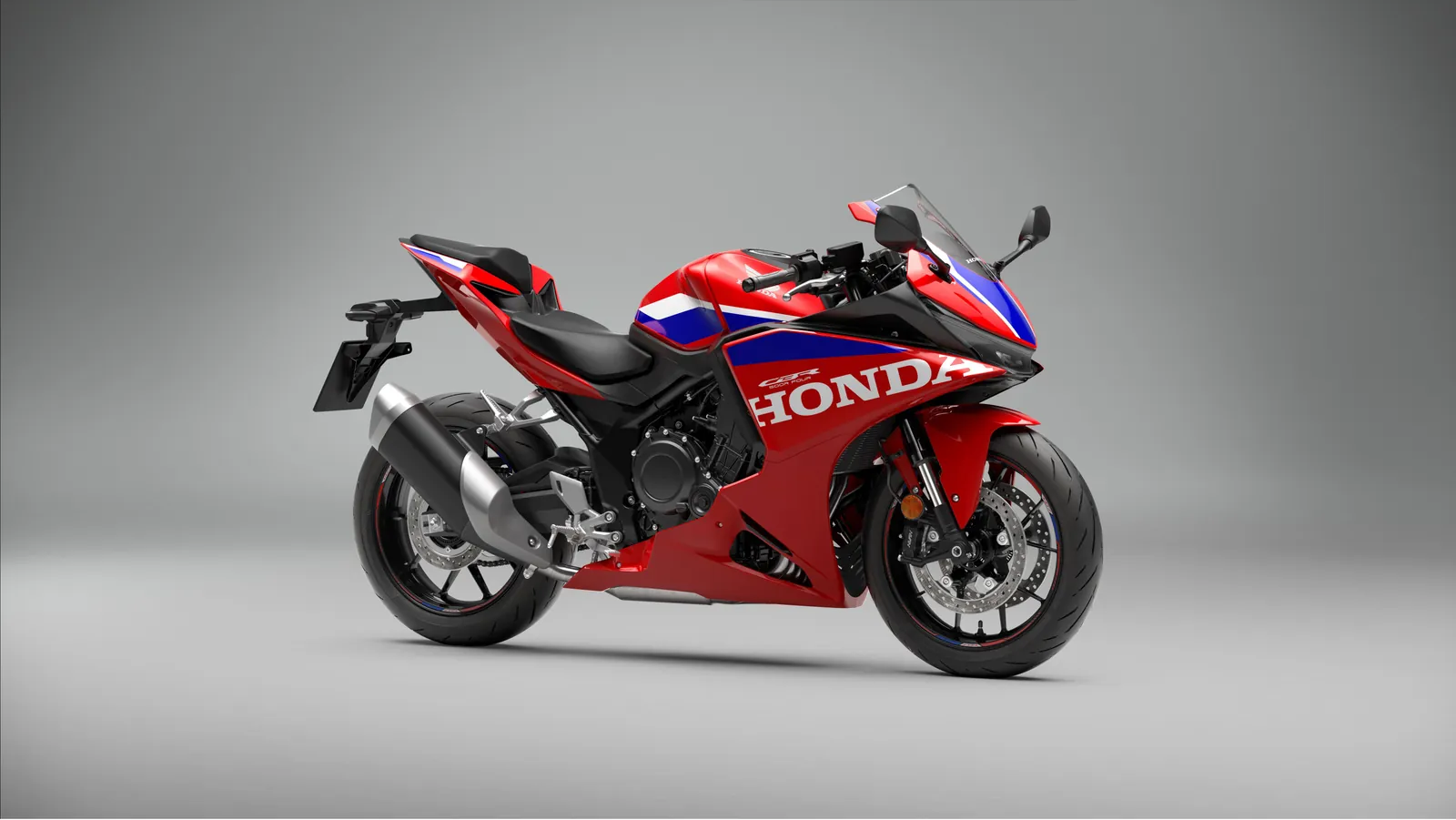
The important part of Honda's CBR500R FOUR name is the last word. This is a different machine from the twin-cylinder CBR500R that has been an A2 favourite for more than a decade, even though the names make them sound like two trims of one bike.
Honda brought the four-cylinder middleweight to EICMA for what its 3 November announcement calls its first showing in Europe, fitted with Honda E-Clutch. The more useful information is on Honda UK's own pages and in the numbers, so that's where we'll start.
What Honda UK lists
The Honda UK model page gives an on-the-road price of £6,999 and these figures:
- Engine: new 500cc inline-four
- Peak power: 51.8kW at 11,000rpm
- Peak torque: 46.3Nm at 10,500rpm
- Kerb weight: 189kg
- Chassis: 41mm KYB inverted fork, Pro-Link rear, Nissin radial-mount front brakes, two-channel ABS
- E-Clutch: fitted, with the lever still there for manual use
Early reports quoted slightly different numbers. Visordown's 20 October coverage gave 53.0kW and 47.4Nm at 9,750rpm, plus a 780mm seat, a 14-litre tank and a 12,500rpm redline. Honda UK doesn't list seat height or tank size. Until it does, treat those as reported figures, and take Honda UK's numbers as the ones to quote.
The twin, the four and the rev counter
Compare those figures with Honda's 2026 twin-cylinder CBR500R release: 471cc, 35kW at 8,500rpm and 43Nm at 6,500rpm.
The four makes about 48% more peak power, but only around 3Nm more peak torque. That torque also arrives 4,000rpm higher. Power depends on torque and engine speed, so the higher revs are an important part of this difference. However, peak figures cannot show how the engines compare at 4,000 or 6,000rpm. That needs full torque curves and riding impressions, rather than an assumption that two similar peak-torque numbers mean similar low-speed response.
The twin had the reverse character: a modest peak, delivered lower down. Neither is better. They just suit different riders. One is happy to keep a smaller engine on the boil with the gear lever. The other wants to short-shift and ride the midrange.
Weight is the surprise. Honda UK's 189kg kerb figure is lighter than the twin's quoted 191kg, despite two extra cylinders, more cams and more exhaust. We'd like to see both bikes weighed the same way before reading too much into a 2kg gap, but the four clearly isn't the heavy option.
The A2 question
Honda UK labels the FOUR as an A2 bike, but 51.8kW is well over the A2 limit. The gov.uk licence rules allow an A2 rider a bike of up to 35kW, with a power-to-weight ratio no higher than 0.2kW per kg. A restricted bike can't be derived from one of more than double the power, so the base bike can't exceed 70kW. The FOUR qualifies for restriction, and Visordown reports a 35kW version. The bike in the window still needs the restricted specification, with paperwork to prove it.
Restricted to 35kW, the FOUR has the same peak-power ceiling as the full-power twin. Acceleration and response can still differ because gearing, torque delivery and weight matter too. If you expect to move to an unrestricted licence later, ask the dealer whether the specific restricted bike can be converted to full power, what that involves and what it costs. Do not assume that every restricted version can be changed in the same way.
Our licence and CBT article covers the wider route into bigger bikes.
E-Clutch is a clutch, not a gearbox
Honda E-Clutch handles the clutch for pulling away, changing gear and stopping. You still choose the gears with your foot. It isn't Honda's DCT, which shifts for you. Honda UK's wording sums it up: use it clutch-free, or pull the lever at any time for manual control.
E-Clutch is also no longer exclusive to the four. The 2026 twin CBR500R release lists it as an option from new. So E-Clutch is a reason to look at either bike, not a reason to pick the four.
On a high-revving four, there's a reason E-Clutch could suit it better than the spec sheet suggests. An engine that wants to be kept between 8,000 and 11,000rpm asks for a lot of gear changes. Clutchless up and down shifts suit that kind of riding, though only road tests will show how well Honda has tuned it.
Used parts and the older CBR500R
The model name is insufficient information for a parts buyer. The FOUR has a different engine layout, so engine, intake, exhaust and electrical compatibility need particular care. Even apparently ordinary fittings should be checked against manufacturer application data. Ask for the model year, market, engine type and part number; earlier FOUR models exist overseas, so age alone does not reliably distinguish the twin from the four-cylinder bike.
For the twin, the arrival of a four-cylinder sibling changes nothing mechanically. If you're weighing a used twin against a new FOUR, our used motorbike buying checklist covers the condition checks.
Who it suits
The CBR500R FOUR makes most sense for a rider who wants the sound and revs of a small four-cylinder sportsbike and expects to keep it after the A2 years. Riders who mainly want easy midrange torque for commuting may still find the twin the more natural match, and it sits beside the four rather than being replaced by it.
What nobody can tell you yet is how the four feels between 3,000 and 7,000rpm on a wet British B-road, where most riding happens. That needs road tests, and the first UK deliveries, which Visordown expects in January 2027.